Best overall for connected home body-composition tracking: Hume Pod 2.0. Best for hands-on skinfold tracking: calipers. Best for waist measurements: a measuring tape. Best for weight-only tracking: a digital scale. Your best BOD POD alternative in 2026 depends on whether you want estimated body composition, circumference measurements, or body weight. Each option answers a different question.
- Hume Pod 2.0 is the best BOD POD alternative here for connected home body-composition tracking without a required core-tracking subscription.
- Skinfold calipers suit readers willing to learn a repeatable measurement technique.
- A measuring tape tracks circumference, not body-fat percentage.
- No home option listed here reproduces the BOD POD measurement method.
What makes the best BOD POD alternative?
- Relevant measurements: Match the measurement to your question.
- Repeatability: Follow the same procedure each time.
- Useful history: Keep results together so you can compare them.
- Manageable effort: Choose a routine you will actually maintain.
- Clear limits: Separate estimates from direct measurements and medical assessments.
Home alternatives at a glance
| Option | Best for | What it measures |
|---|---|---|
| Hume Pod 2.0 | Connected body-composition tracking | Body-composition estimates recorded in the companion app |
| Skinfold calipers | Hands-on skinfold tracking | Skinfold thickness at selected sites |
| Measuring tape | Waist and circumference tracking | Changes in specific body measurements |
| Digital weight scale | Weight-only tracking | Total body weight |
These are ranked by their usefulness for different home-tracking needs, not by a claim that one method produces universally more accurate results. Start with the measurement you need, then choose the tool.
1. Hume Pod 2.0: best BOD POD alternative for connected tracking
Hume Pod 2.0 is an at-home body-composition analyzer that works with the companion app. It suits readers who want body-composition information rather than weight alone, with results kept together for reviewing changes over time.
Hume Pod 2.0 suits adults who want connected home body-composition tracking with no required subscription for core app tracking. Premium coaching and deeper personalized analysis are optional paid upgrades; they are separate from included tracking.
What the measurements help you decide
Body-composition tracking gives you another perspective alongside body weight. Use the history to review whether your measurements are moving consistently while you maintain habits such as regular strength training, walking, and a steadier sleep schedule.
Do not treat an isolated change as proof that a particular meal or workout caused it. An estimate is useful context, not a direct explanation of what happened inside your body.
Hume Pod 2.0 highlights
- Brings at-home body-composition tracking into a connected app experience.
- Includes core app tracking without a required subscription.
- Lets you review body-composition history rather than recording weight alone.
- Fits readers who prefer a connected device to manual measurement logs.
Do you also need the wearable?
Hume Band 2.0 is a separate health-tracking wearable for understanding sleep, activity, strain, recovery, and health trends. It works on its own; Hume Pod 2.0 is optional. The companion app brings body-composition and wearable insights together when you use both.
Choose the analyzer when your buying question is about body composition. Consider the wearable when your main question concerns daily activity, sleep, or recovery, not as a substitute for a body-composition measurement.
Best for: Adults who want connected body-composition tracking at home rather than a weight-only record.
Hume Pod 2.0 suits people who want an app-based view of body-composition trends.
2. Skinfold calipers: best for hands-on skinfold tracking
Skinfold calipers measure the thickness of a fold of skin and underlying subcutaneous fat at selected body sites. Body-fat equations use those measurements to estimate body-fat percentage; the caliper itself does not directly measure total body fat.
This option fits someone who prefers a manual process and is willing to learn it properly. Some measurement sites are difficult to reach alone, so self-measurement is not equally practical for every protocol.
What the measurements help you decide
A consistent skinfold record lets you compare the same sites over time. The most useful question is whether those measurements are changing under the same procedure, not whether a calculated percentage matches a smart scale.
Choose a recognized protocol and keep the measurement sites, technique, and equation consistent. Switching the equation while keeping the measurements changes the meaning of your record.
Skinfold caliper highlights
- Provides site-specific skinfold measurements.
- Works without a connected app.
- Lets you retain the original measurements alongside any calculated estimate.
Best for: Readers who enjoy hands-on tracking and can follow the same measurement protocol each time.
Calipers suit people who are comfortable learning a consistent, hands-on measurement technique.
3. Measuring tape: best for waist and circumference tracking
A flexible measuring tape records circumference at a defined location, such as your waist. It does not tell you how much of your body is fat or muscle, but it answers a clear question: is this particular measurement changing?
That makes a tape a useful alternative when your real goal is tracking body-size changes rather than obtaining a body-fat estimate. Keep the measurement location and tape tension consistent.
What the measurements help you decide
Circumference measurements add context when weight alone does not describe the change you notice. You can compare a waist record with clothing fit, your weight history, and the habits you have maintained.
A waist measurement that changes by 1 cm describes a circumference difference; it does not identify how much fat changed. That distinction keeps a simple measurement useful without asking it to explain more than it can.
Measuring tape highlights
- Records a specific body measurement without an app.
- Complements body-weight and body-composition records.
- Avoids turning every observation into a body-fat percentage.
Best for: Adults whose main question is whether their waist or another defined circumference is changing.
A measuring tape suits people who want to follow changes in waist size or another specific circumference.
4. Digital weight scale: best for weight-only tracking
A digital weight scale measures total body weight. It is the clearest choice when you do not need body-fat estimates and want a straightforward record you can review over time.
Weight is a useful measurement, but it combines everything on the scale. It cannot tell you which tissues or fluids account for a change.
What the measurements help you decide
Use weight history to understand the direction of your overall body-weight trend. Record enough context to avoid mistaking a single reading for a complete assessment of your habits.
For example, a 1 kg difference between readings is a body-weight difference, not proof of a matching fat change. Water, food, and other factors contribute to what the scale measures.
Digital weight scale highlights
- Answers a clear, familiar measurement question.
- Requires no body-composition equation to report weight.
- Fits readers who prefer a simple tracking routine.
Best for: Readers who want weight tracking without additional body-composition estimates.
A digital scale suits people who want a straightforward weight record without body-composition estimates.
How to make home measurements useful in 2026
The value of home tracking comes from a repeatable routine and a clear question. Use this sequence whether you choose a connected analyzer, calipers, a tape, or a weight-only scale.
Choose your question
Decide what you want to understand before collecting more measurements. Body composition, waist circumference, and body weight are related topics, but they are not interchangeable measurements.
Repeat the setup
Follow the device instructions or measurement protocol each time. For scale-based tracking, keep the measurement setting and timing consistent; for tape and calipers, keep the sites and technique consistent.
Record context
Keep brief notes about relevant circumstances, such as a different measurement time or a recent change in routine. Context helps you spot readings that deserve a careful recheck instead of an immediate reaction.
Review the trend
Look at the history before changing your habits. Ask whether the pattern persists under comparable conditions and whether it agrees with other observations, rather than demanding that every reading move in the same direction.
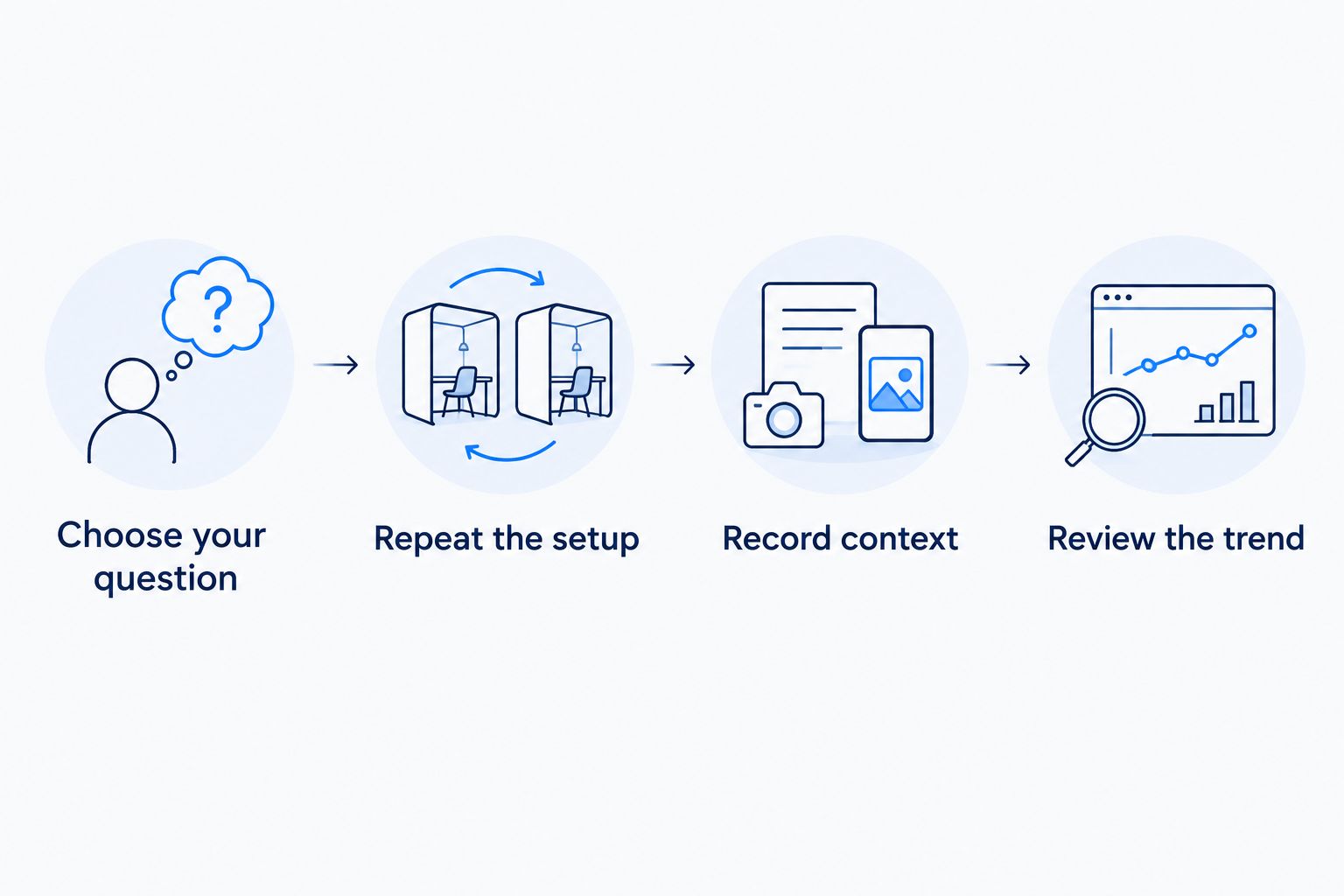
A simple log can separate 2 questions: what changed in the measurement, and what changed in your routine? Keeping those questions separate prevents you from treating an observation as proof of its cause.
What BOD POD alternatives cannot tell you
No option in this guide diagnoses a medical condition or replaces medical care. A reassuring trend does not explain symptoms, and an unexpected reading is not a diagnosis.
Body-fat percentage also needs careful interpretation. A change from 30% to 29% is a decrease of 1 percentage point, but an estimated change does not by itself establish that your body composition changed by exactly that amount.
Avoid combining different methods into a single uninterrupted body-fat record. If you switch from BOD POD assessments to a home analyzer in 2026, start a clearly labeled home baseline instead of treating the first reading as a precise increase or decrease.
How these alternatives were ranked
The comparison focuses on what each tool measures, how easily you can repeat the measurement, and how you keep a useful record. Hume Pod 2.0 combines body-composition estimates with an app-based history. Calipers, tape measures, and weight-only scales suit people who want a more specific measurement.
This guide compares how the tools fit different routines. It is not a head-to-head accuracy study. There is no claim here that Hume Health or any other home option matches BOD POD results or performs better across every measurement need.
Which BOD POD alternative should you choose?
Choose Hume Pod 2.0 if you want connected body-composition tracking and included core app tracking without a required subscription. Choose calipers if you want to learn skinfold measurement, a tape if circumference is your priority, or a digital scale if weight is enough.
For your 2026 routine, start with the smallest set of measurements that answers your actual question. More devices do not automatically create a clearer decision, especially when their methods and outputs differ.
FAQ
What's the best BOD POD alternative for home use in 2026?
Hume Pod 2.0 is the best fit in this guide for connected home body-composition tracking with no required subscription for core app tracking. A measuring tape or digital weight scale fits better if you only need circumference or weight.
Is a home body-composition analyzer the same as BOD POD?
No, a home body-composition analyzer is not the same as BOD POD. BOD POD uses air displacement, so results from another method should not be treated as interchangeable.
Can I measure body-fat percentage with a measuring tape?
A measuring tape directly measures circumference, not body-fat percentage. Some equations use circumference measurements to estimate body fat, but that estimate is separate from the measurement itself.
Do I need a subscription to use Hume Pod 2.0 core app tracking?
No, Hume Pod 2.0 core app tracking does not require a subscription. Premium coaching and deeper personalized analysis are optional paid upgrades.
Do I need Hume Pod 2.0 to use Hume Band 2.0?
No, Hume Band 2.0 works on its own, and Hume Pod 2.0 is optional. The wearable supports tracking sleep, activity, strain, recovery, and health trends rather than replacing a body-composition analyzer.
Why doesn't my home body-fat estimate match my BOD POD result?
Different measurement methods use different assumptions and procedures, so their estimates are not interchangeable. Keep separate records for each method and compare readings collected under consistent conditions.
Should I choose calipers or a smart body-composition analyzer?
Choose calipers if you want hands-on skinfold tracking and will learn a consistent protocol. Choose a connected analyzer if you prefer an app-based body-composition record with less manual logging.
One last thing
Your next reading does not need to match your last BOD POD result to be useful. It needs a consistent method, a clear label, and enough context to support a sensible comparison with future readings.
Before starting your 2026 tracking routine, write down one question you want the measurements to answer. Hume Health body-composition tracking is a fit when that question concerns connected body-composition trends; simpler tools deserve the choice when your question is simpler.